
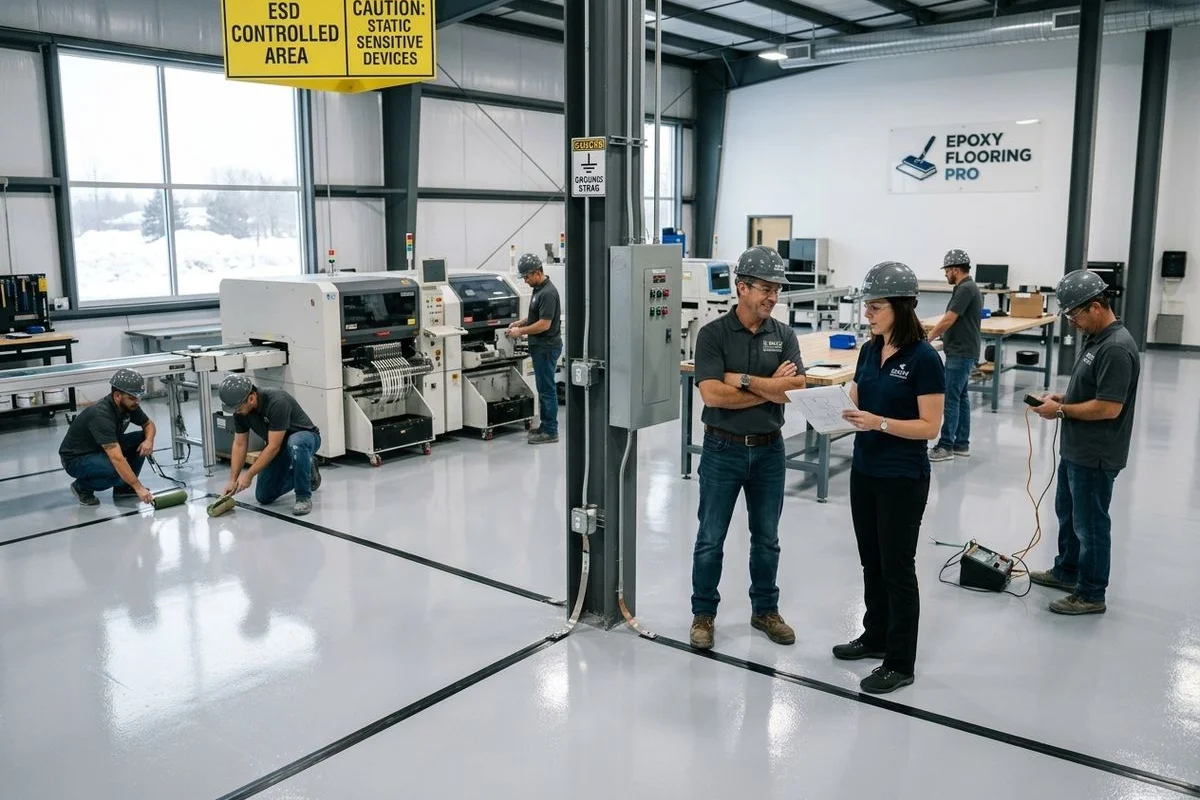
Certified ESD & Conductive Flooring in Grand Rapids, MI
ANSI/ESD S20.20 compliant electrostatic dissipative and conductive flooring for Grand Rapids electronics, pharmaceutical, and aerospace facilities.
Why ESD Flooring Failures Are Never Just a Flooring Problem
When an electrostatic discharge event damages a circuit board at a Zeeland electronics facility, contaminates a pharmaceutical batch on Medical Mile, or triggers an ignition event, the floor is rarely the first thing investigated. But in many ESD-related incidents, the floor system’s failure to reliably dissipate static charge is a contributing factor.
Standard epoxy floors conduct static unpredictably. Without a properly installed grounding grid and a coating system with verified, stable resistance values, the floor may perform adequately on installation day and drift out of specification within 18 months. Grand Rapids’ growing pharmaceutical and electronics manufacturing sectors — GRAM’s five facilities, Gentex’s automotive electronics, Viant Medical’s device campus, and dozens of Medical Mile research labs — cannot afford that risk.
Epoxy Flooring Pro designs, installs, and certifies ESD floor systems for Grand Rapids area facilities engineered to hold their resistance specification reliably across the system’s operational lifespan.
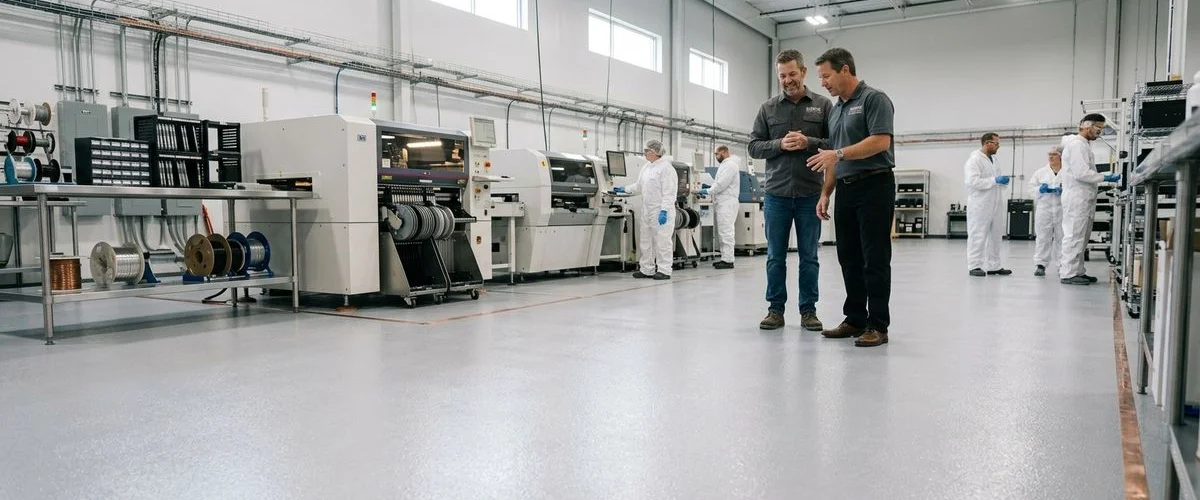
Understanding ESD Floor Requirements for Grand Rapids Facilities
Resistance Classification
Conductive flooring (Rg < 1×10^6 Ω) is used where rapid charge dissipation is critical — explosive handling and certain semiconductor processes.
Static dissipative flooring (Rg 1×10^6 to 1×10^9 Ω) provides controlled dissipation appropriate for most Grand Rapids electronics manufacturing, pharmaceutical, and medical device environments.
Why Grounding Grids Are Non-Negotiable
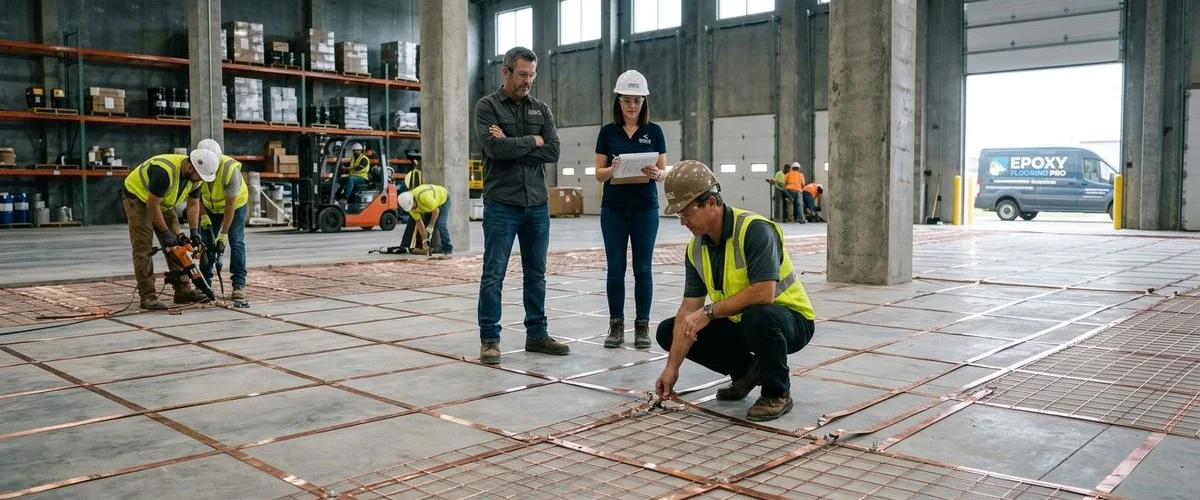
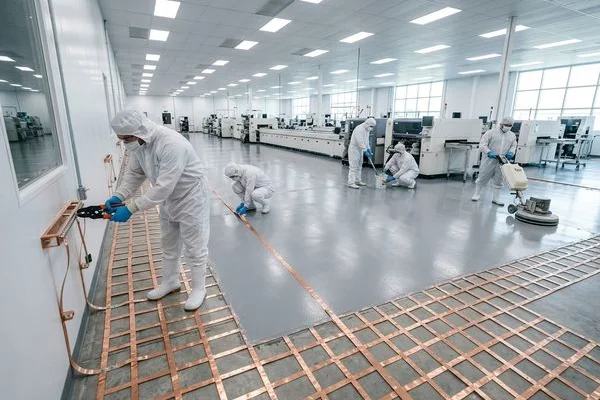
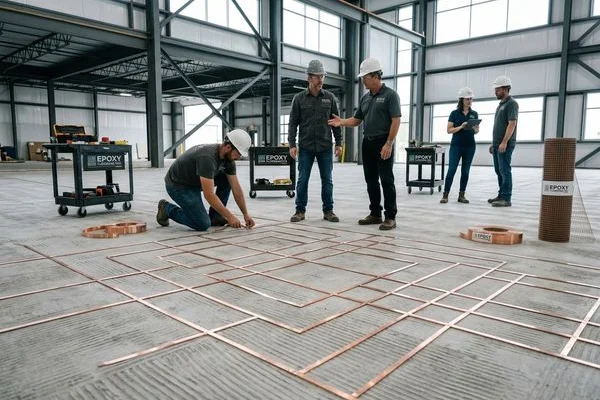
Many ESD floor failures trace to inadequate grounding. An ESD coating without a properly installed grounding grid is like a drain without a sewer connection. Our copper grounding grid installations provide a true, measurable path to ground from every point on the floor surface — tested and documented before project closeout.
The ESD Floor System Stack
Conductive Primer
Fills the concrete profile and provides the initial conductive pathway connecting topcoat to grounding grid. We use two-component epoxy conductive primers that cure to stable, verified resistance ranges.
ESD Intermediate Coat
Builds mil thickness while maintaining conductivity continuity — important for Grand Rapids facilities with heavy chemical exposure or high abrasion from pharmaceutical and manufacturing operations.
Static-Dissipative Topcoat
The surface layer that takes wear, cleaning chemistry, and physical contact. Formulated to maintain resistance values across the expected service life and resist the cleaning agents used in Medical Mile facilities.
Certified Testing and Documentation
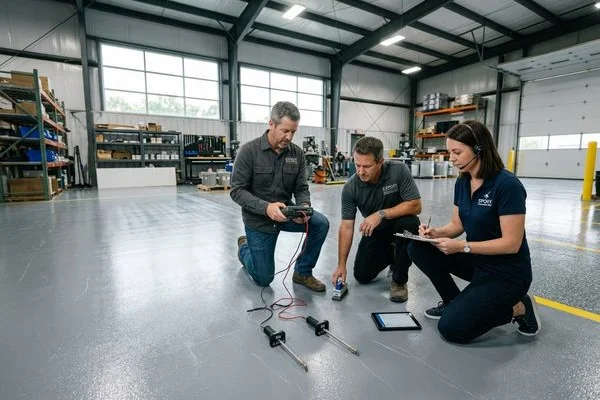
Every installation is tested per ANSI/ESD S7.1 using calibrated megohmmeter equipment across a systematic grid pattern. Test reports include point-to-point and resistance-to-ground readings, pass/fail determination, photographs, and tester credentials. This documentation integrates directly into your ANSI/ESD S20.20 control program.
Applications Across Grand Rapids and West Michigan
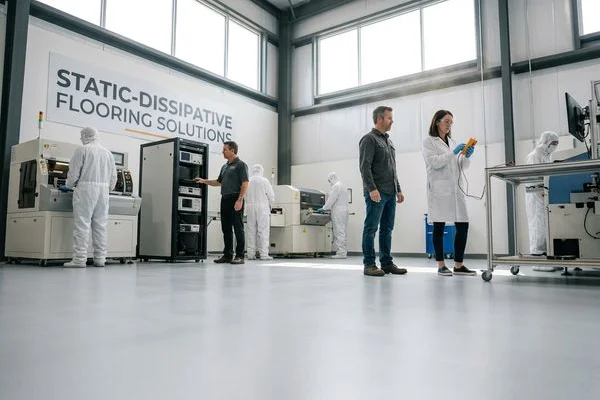
Electronics Manufacturing: PCB assembly and SMT lines at Gentex, Zeeland area electronics suppliers, and Grand Rapids contract manufacturers.
Pharmaceutical Manufacturing: GRAM’s five facilities, Perrigo’s operations, and Medical Mile research labs where static can cause powder agglomeration or contamination.
Medical Devices: Viant Medical’s 108,000 sq ft campus and other ISO-certified manufacturing environments in the Grand Rapids area.
Aerospace and Defense: West Michigan aerospace component manufacturers requiring MIL-STD-1686 compliance.
Data Centers: Server rooms and equipment staging areas in Grand Rapids’ growing tech sector.
Contact Epoxy Flooring Pro for a static control flooring assessment at your Grand Rapids facility. We will specify the right system, install it correctly, and deliver the documentation your ESD program requires.
What's Included
Our ESD Flooring Installation Process
Facility & Risk Assessment
We assess your static-sensitive processes, equipment, and environments to determine the required resistance range — conductive (Rg < 1×10^6 Ω) or static dissipative (Rg 1×10^6 to 1×10^9 Ω).
System Specification
We specify the appropriate ESD flooring system — epoxy, urethane, or vinyl ester based ESD formulation — matched to your chemical exposure, cleanroom classification, and foot traffic.
Concrete Preparation
Diamond grinding to ICRI CSP 3–4 removes surface contaminants and opens the concrete profile for maximum primer adhesion. Moisture testing is performed before application begins.
Copper Grounding Grid Installation
Copper tape grounding grids are installed in a pattern that ensures every point on the floor surface meets the specified resistance to ground within the required range.
ESD Coating Application
Conductive primer, ESD-rated intermediate coat, and static-dissipative topcoat are applied in controlled conditions, with mil thickness verified at each stage.
Certified Testing & Documentation
Point-to-point resistance testing is performed across a grid pattern per ANSI/ESD S7.1. Results are documented in a formal test report provided to you for your ESD control program records.
Why Choose Epoxy Flooring Pro
Certified ESD Compliance
We provide formal resistance test documentation that meets ANSI/ESD S20.20 and IEC 61340-4-1 requirements — what Grand Rapids pharmaceutical and electronics facilities need for audit compliance.
Grounding Grid Expertise
Proper grounding separates a functional ESD floor from a standard epoxy floor with additives. We design and install copper grounding systems that deliver reliable, consistent resistance.
Cleanroom Compatible
Our ESD systems use low-VOC, low-outgassing formulations compatible with ISO-classified cleanrooms — critical for GRAM's pharmaceutical facilities and Medical Mile research labs.
Ongoing Recertification Support
ESD floors require periodic retesting. We offer recertification services and can diagnose resistance drift before it causes compliance failure.
Project Gallery
What Our Clients Say
"We needed ANSI/ESD S20.20 compliant flooring in our Grand Rapids pharmaceutical cleanroom with documented test results. Epoxy Flooring Pro delivered the installation, grounding system, and complete test report. Our ESD audit passed with no findings."
"Static events in our Zeeland electronics assembly room were costing us product. Epoxy Flooring Pro specified the right resistance range for our Gentex components, installed the copper grid, and certified the floor. Zero static events since installation."
Frequently Asked Questions
What is the difference between conductive and static dissipative flooring?
What standards does your ESD flooring comply with?
Is the copper grounding grid included?
Can ESD flooring be installed in a cleanroom?
How often does ESD flooring need retesting?
Can an existing floor that has lost its ESD properties be restored?
Get a Free Estimate for ESD Flooring
Our project managers are ready to assess your facility and recommend the optimal esd flooring solution.