
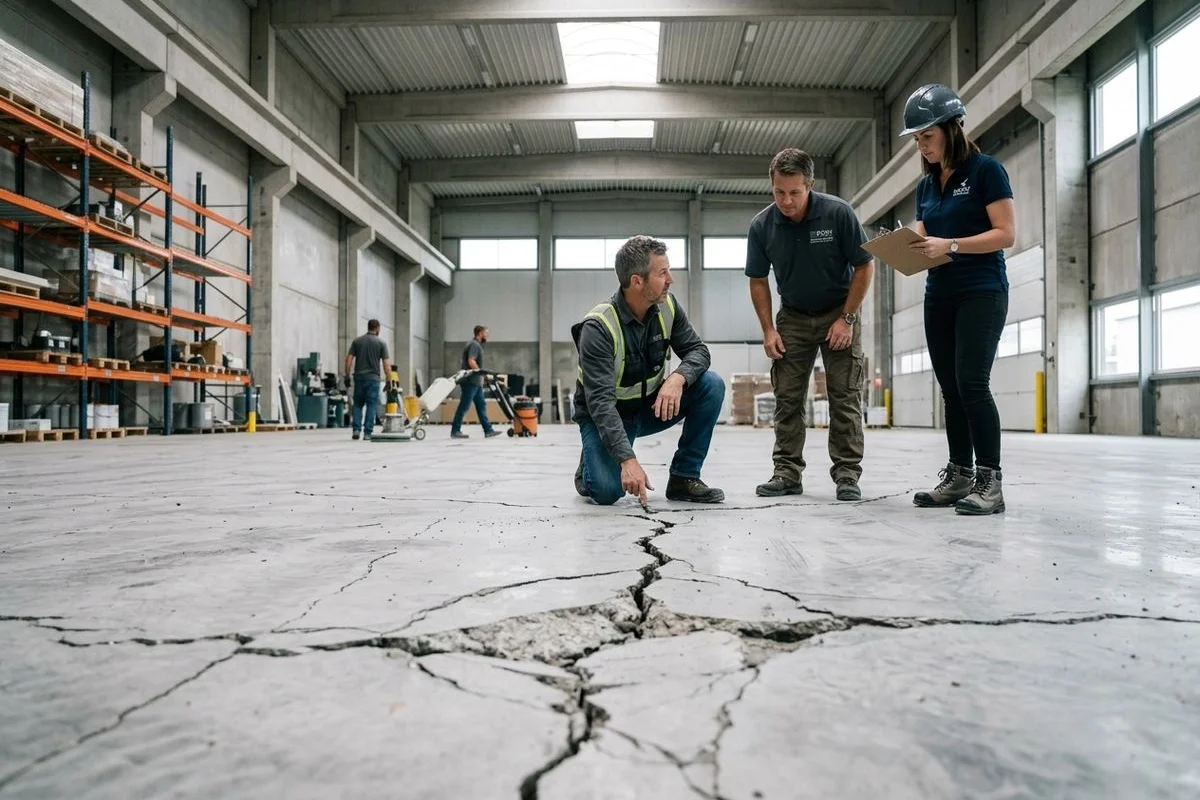
Industrial Concrete Repair & Joint Sealing in Grand Rapids, MI
Structural concrete restoration, crack bridging, control joint sealing, and substrate preparation for Grand Rapids industrial floors damaged by West Michigan's freeze-thaw cycles.
Why Concrete Repair Is Critical for Every Grand Rapids Floor Coating Project
Every industrial floor coating project lives or dies by the condition of the substrate beneath it. The highest-quality epoxy or urethane system will fail prematurely if applied over cracked, spalled, or improperly prepared concrete. Yet in Grand Rapids’ competitive bidding environment, substrate repair is frequently the first item contractors reduce to lower their price.
West Michigan’s climate makes this problem especially acute. Grand Rapids averages 65–75 inches of snow annually, with lake-effect storms that can dump over 100 inches in heavy years. Temperatures cross the 32°F freeze-thaw threshold hundreds of times per winter, driving moisture into unprotected concrete, expanding as ice, and progressively destroying the slab from within. Loading docks, warehouses with open overhead doors, and manufacturing bays along the I-96 corridor are especially vulnerable.
At Epoxy Flooring Pro, thorough concrete repair is non-negotiable. It is the foundation of every coating system we install across Grand Rapids, Walker, Wyoming, Kentwood, and the broader West Michigan region.
Understanding Crack Types in West Michigan Industrial Floors
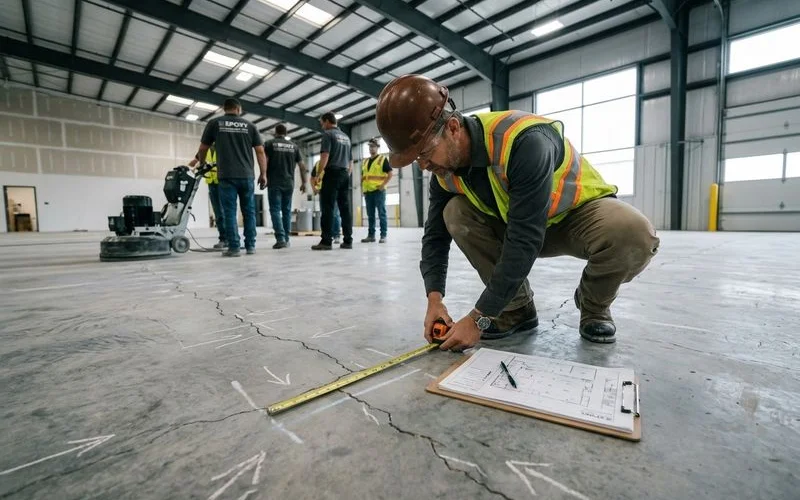
Industrial floor cracks are not all the same, and treating them identically is a critical error. Grand Rapids’ climate creates unique crack patterns that require experienced assessment:
Dormant Structural Cracks
Dormant structural cracks occurred due to overloading, inadequate reinforcement, poor base preparation, or drying shrinkage — but are no longer actively moving. These cracks represent a loss of tensile continuity that, if unrepaired, can propagate under operational loading.
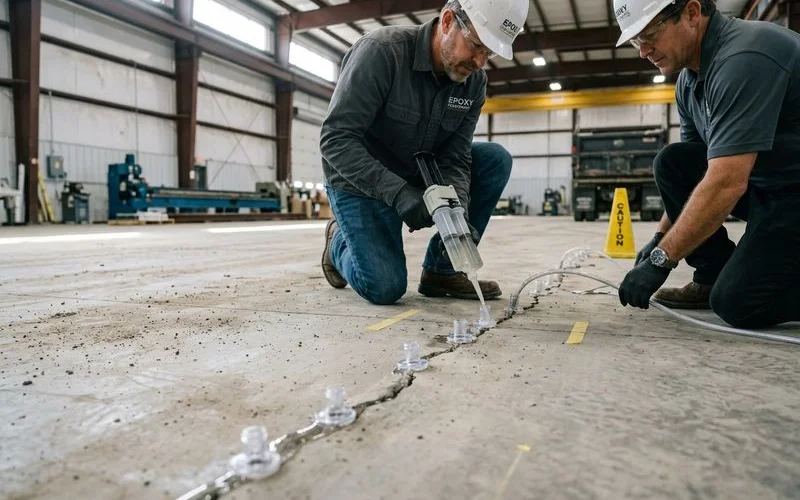
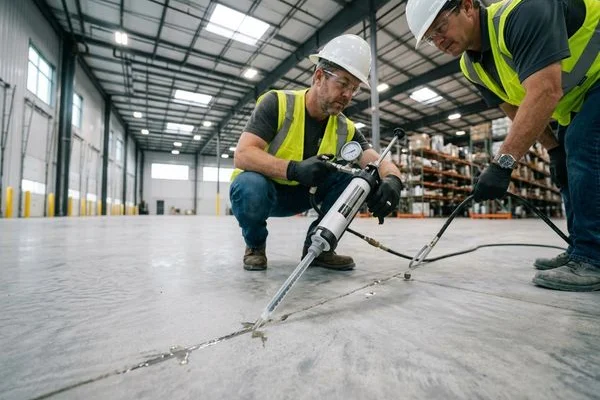
The correct repair is low-viscosity epoxy injection under pressure. When properly executed, epoxy injection restores tensile and shear strength across the crack plane. This is critical before applying any polished concrete or coating system to Grand Rapids facility floors.
Active Cracks
Active cracks still exhibit cyclic movement — particularly common in Grand Rapids where extreme thermal cycling between lake-effect winters and humid summers drives significant slab movement. Injecting active cracks with rigid epoxy is counterproductive — the stress transfers to the crack boundaries, which re-crack adjacent to the repair.
Active cracks require semi-rigid polyurea that accommodates cyclic movement while maintaining a sealed joint. The polyurea is installed at a precisely controlled depth-to-width ratio with appropriate backer rod.
Control Joint Failure: The Leading Source of Coating Problems in West Michigan
Walk through any Grand Rapids industrial facility with a failed floor coating and failures cluster at or near control joints. This is not coincidence. Control joints are engineered movement points that experience more movement than any other part of the floor — and West Michigan’s extreme temperature swings amplify that movement beyond what many joint filler materials can accommodate.
Why Old Mastic Must Be Completely Removed
Legacy control joint mastic deteriorates over time. Plasticizers migrate out, the mastic stiffens and shrinks, and adhesion to the concrete joint walls is lost. Many Grand Rapids contractors apply new filler over old mastic without complete removal — the new material bonds to the failing old mastic rather than to concrete. When the old mastic fails, it takes everything with it.
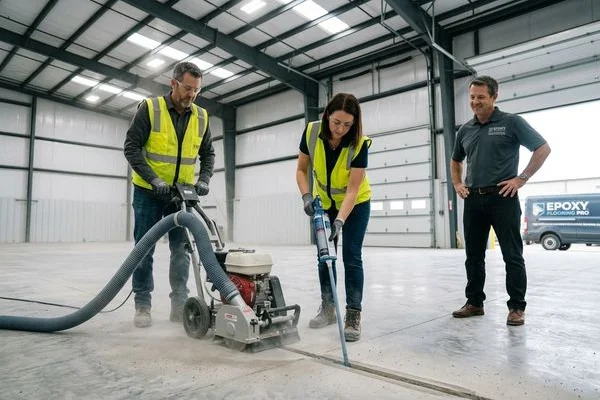
Our process: complete removal of all existing joint filler using diamond-blade routers, followed by vacuuming and compressed air blow-out before any new material is applied.
Backer Rod and Correct Aspect Ratio
Control joint fillers require correctly sized closed-cell foam backer rod to control filler depth-to-width ratio (target 1:1), prevent three-sided adhesion that causes premature failure, and provide a backing surface that allows the filler to stretch in tension. This detail is what most West Michigan contractors either skip or execute incorrectly.
Spall Repair: Addressing Freeze-Thaw Surface Damage
Surface spalls — the pop-outs and delamination common in Grand Rapids facilities exposed to salt, de-icers, and freeze-thaw cycling — require more than filling with mortar:
- Match the surrounding concrete’s surface profile so repairs don’t telegraph through the coating
- Achieve compressive strength equal to or greater than the parent concrete
- Bond adequately to the prepared substrate without stress concentration
- Resist shrinkage cracking — a problem with high-cement-content mortars
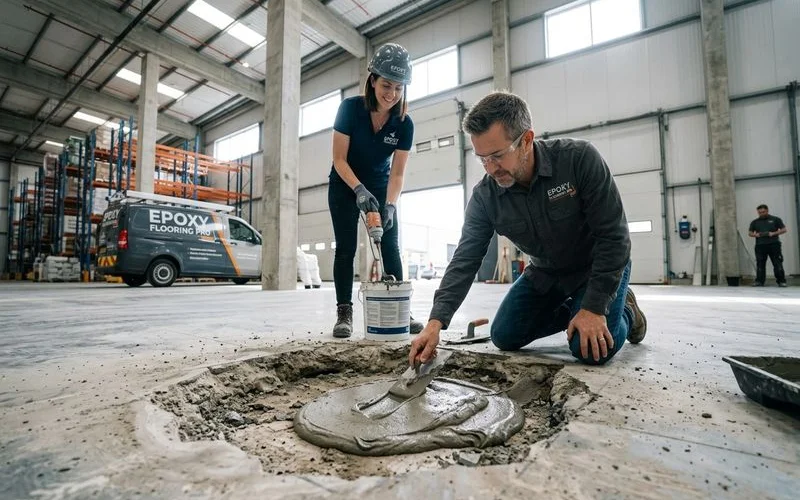
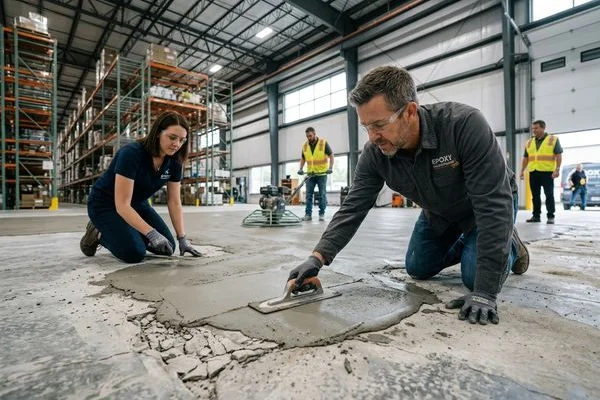
We select repair mortars matched to each situation: fast-set cementitious for minor surface spalls, epoxy mortars for high-stress locations, and micro-topping systems for large-area deterioration common in older Grand Rapids industrial buildings.
Moisture Vapor: West Michigan’s Hidden Floor Coating Killer
Moisture vapor emission from concrete slabs is the most frequently overlooked and destructive condition for floor coatings. Grand Rapids’ 71% average humidity, high winter moisture, elevated water tables, and seasonal ground moisture create vapor drive conditions that exceed many coating system tolerances.
We perform ASTM F1869 calcium chloride testing and ASTM F2170 in-situ relative humidity testing on all projects. When moisture vapor rates exceed thresholds, we specify:
- Moisture-tolerant epoxy primers that maintain adhesion at higher moisture levels
- Vapor barrier primer systems that physically block vapor transmission
- Cementitious vapor barrier membranes for extreme cases with hydrostatic pressure
Ignoring moisture vapor is how contractors create short-term profits and long-term customer problems. We specify the correct system upfront rather than dealing with delamination callbacks six months later.
Integrating Repair with Coating Specifications for West Michigan Facilities
Because we perform both repair and coating installation, our repair specifications always consider the full coating system:
- Repair mortar hardness must be compatible with surface preparation equipment
- Joint filler hardness must match the coating system’s flexibility requirements
- Repair material surface texture must match the surrounding concrete profile
When repair and coating are performed by different contractors — common in Grand Rapids’ competitive-bid environment — the repair contractor optimizes for their scope without regard to coating compatibility. The result is frequently a system that fails not because either contractor did poor work, but because their materials were incompatible.
Contact our estimating team to schedule a comprehensive substrate assessment at your Grand Rapids facility and receive a fully integrated repair-and-coating specification.
What's Included
Our Joint & Crack Repair Installation Process
Comprehensive Substrate Investigation
We perform a systematic inspection of the entire floor area: mapping all cracks by type (structural vs. shrinkage, active vs. dormant), measuring crack widths and depths, probing for delaminated concrete (sounding), testing for moisture vapor emission, and pH testing. Contamination zones are identified through visual inspection and core sampling where indicated.
Crack Classification and Repair Method Selection
Not all cracks are repaired the same way. Dormant structural cracks receive rigid epoxy injection to restore tensile strength across the crack face. Active cracks that exhibit movement — from thermal cycling, loading, or settlement — require semi-rigid polyurea that can flex with the slab without re-cracking. Hairline shrinkage cracks below the coating threshold are treated with penetrating primers that bridge without bridging compound.
Control Joint Preparation
Control joints are routed to a clean, uniform width and depth using diamond-blade crack chasers. Old failed mastic, foam backer, or dirt is completely removed. Joints are vacuumed clean and blown out before any filler product is applied. The routing width and depth determines the correct backer rod diameter and filler aspect ratio for long-term performance.
Repair Material Installation
Epoxy injection ports are drilled and set along structural cracks at intervals determined by crack depth. Low-viscosity, moisture-insensitive epoxy is injected under pressure until the full crack depth is saturated. Polyurea joint fillers are poured into prepared control joints over properly sized backer rod, then allowed to cure before grinding flush.
Spall and Surface Defect Repair
Spalls, pop-outs, bug holes, form tie holes, and surface voids are repaired with high-strength cementitious or epoxy mortar matched to the substrate's compressive strength. Repairs are feathered to blend with the surrounding surface profile to prevent coating bridging or print-through.
Surface Preparation and Verification
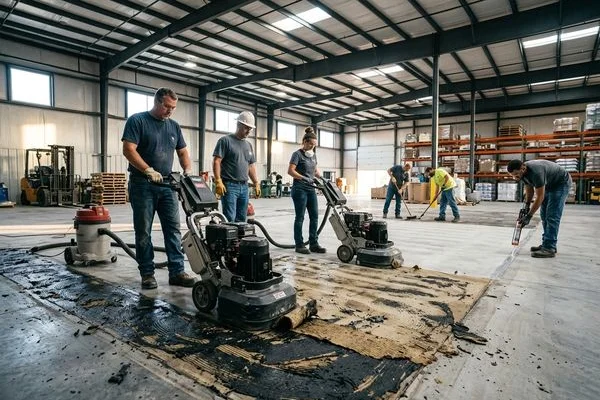
All repairs are ground flush. The entire floor is shot blasted or diamond-ground to the specified ICRI profile. A final walk-through inspection confirms no missed cracks, open joints, or surface defects remain. Written documentation of all repairs with photographic records is provided before coating application begins.
Why Choose Epoxy Flooring Pro
Repair-Specialist Mindset
We treat concrete repair as a specialty discipline, not a background task. Our crews are specifically trained in crack classification, repair material selection, and injection techniques.
Correct Crack Classification Every Time
The most costly mistake in concrete repair is using rigid filler in an active crack. Grand Rapids' extreme thermal cycling makes correct classification critical — we assess every crack for movement before selecting repair methods.
Proper Joint Geometry
Control joint filler must be installed at the correct depth-to-width ratio over proper backer rod. Overfilling or underfilling joints is extremely common. We train our crews specifically on joint geometry because it determines how long the repair lasts.
Full Documentation
Every repair is photographed before and after with a written repair log noting crack locations, classification, repair method, and materials used.
Integrated with Coating Systems
Because we both repair and coat industrial floors, our repair specifications always account for the planned coating system — ensuring material compatibility from substrate to topcoat.
Project Gallery
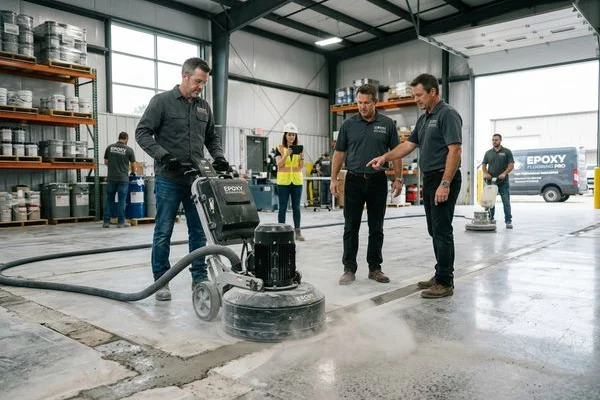
Before & After
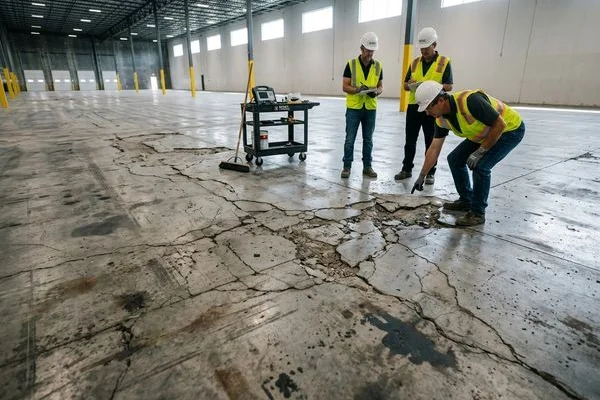
Before
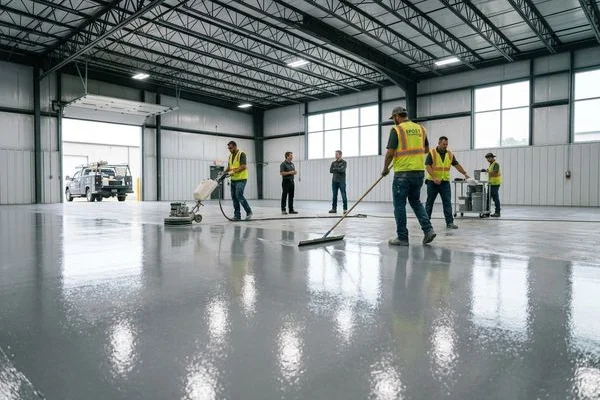
After
What Our Clients Say
"Three previous contractors had coated our Grand Rapids manufacturing floor and it kept failing at the joints. Epoxy Flooring Pro took core samples, classified every crack, and properly repaired the substrate before coating. Two years later — zero failures. The difference was understanding West Michigan's freeze-thaw damage patterns."
"Our Wyoming warehouse had significant slab cracking from years of heavy forklift traffic and harsh winters. Their team documented everything, specified the correct repair approach for each crack type, and completed the work before starting the coating. Fourteen months in service with zero coating issues at any repair location."
"I was impressed by how methodical their assessment was at our Kentwood facility. They mapped every crack, noted the type, tested for moisture — which was elevated due to our high water table — and explained exactly what they were going to do. That engineering rigor is unusual in the Grand Rapids market."
Frequently Asked Questions
How do you determine whether a crack needs rigid epoxy or semi-rigid polyurea in Grand Rapids facilities?
Can you repair a Grand Rapids facility floor that is still in service?
Why do control joints fail so commonly in West Michigan industrial floors?
Our Grand Rapids facility has extensive oil contamination in the concrete. Can it be coated?
How much does concrete repair add to a Grand Rapids floor project cost?
Get a Free Estimate for Joint & Crack Repair
Our project managers are ready to assess your facility and recommend the optimal joint & crack repair solution.